
Plugging In, Tuning Up, and Taking Third
Three years after converting its Formula SAE car to electric power, Panther Racing posted its best finish in team history
Folk singer Bob Dylan famously took the stage at the Newport Folk Festival in 1965, plugged in an electric guitar, and began belting out songs. Shocked and outraged fans, expecting him to strum his acoustic guitar, left. How could Dylan go electric?
Three years ago, Panther Racing, the University of Pittsburgh’s Formula SAE team, set out in the sub-basement of Benedum Hall to build its first electric race car. After 35 years of designing and racing formula-style cars powered by internal combustion engines, the team was ready for a change.
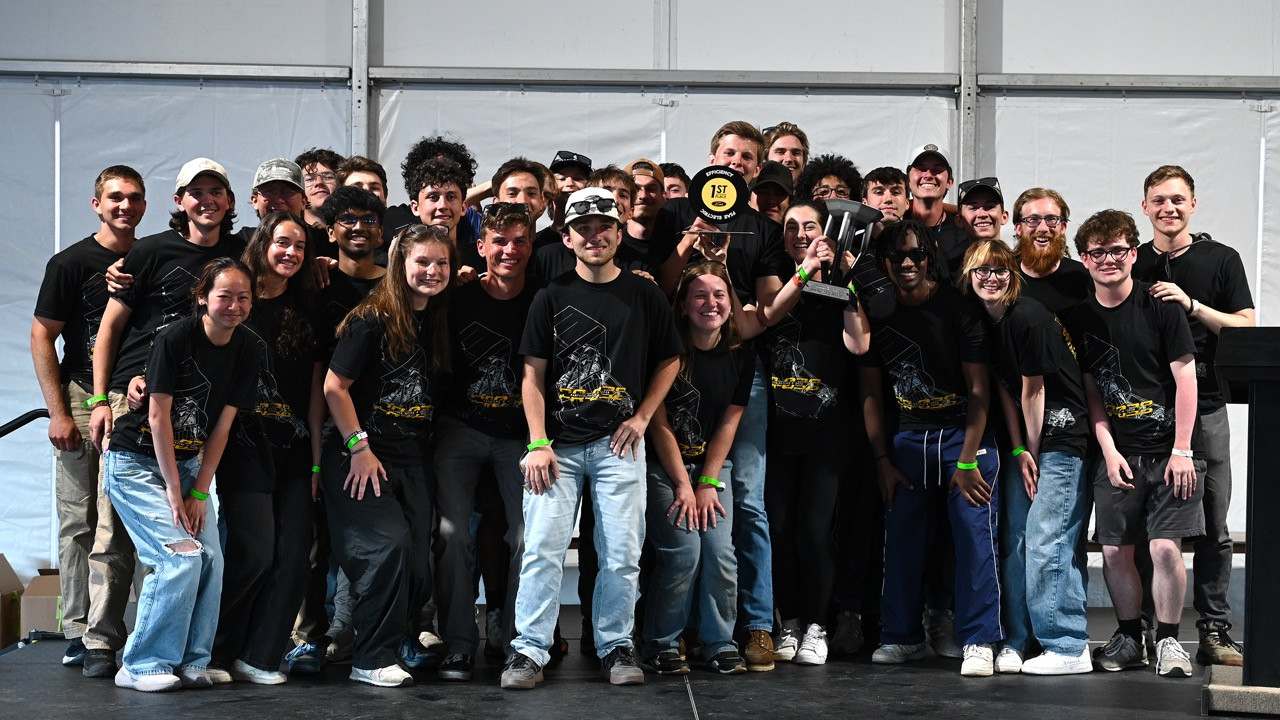
That decision ultimately required Panther Racing to rethink nearly every aspect of its car. The results became clear in June, at Michigan International Speedway, where the team placed third among 108 competitors, the best finish in Panther Racing history.
This success drew from an unusually broad range of interests and skills. “We have members studying pre-med, nursing, biology, public health – all kinds of students with different skills,” said Helena Ciavarelli (BS MEMS ’26), Panther Racing’s executive director this past year. For many of these members, transforming a race car has had the unexpected result of changing how they see themselves and their futures.
Building engines in wheels
Panther Racing was founded in 1988 and has built a new car each year to specifications that change when the annual FSAE rule book is released. Some years, the team makes incremental changes while in others they start from scratch. When the team decided to go electric, they wanted to keep it simple at first.
“There's a lot going on with electric,” said Emmett Gillis, a fourth-year mechanical engineering student and this year’s technical director. “The first two years, we just had a single motor with a chain drive to the diff [differential] powering the rear wheels.”
The team worried about how they would fare that first year after going electric. “Our only goal was to pass the rigorous technical inspections that they have,” said Ciavarelli.
Not only did they easily pass, but they placed sixth in Electrical Design, one of the many categories by which teams are judged. In 2025, Panther Racing did even better, finishing sixth overall.
They’d proved they could go electric. Now it was time to get complicated.
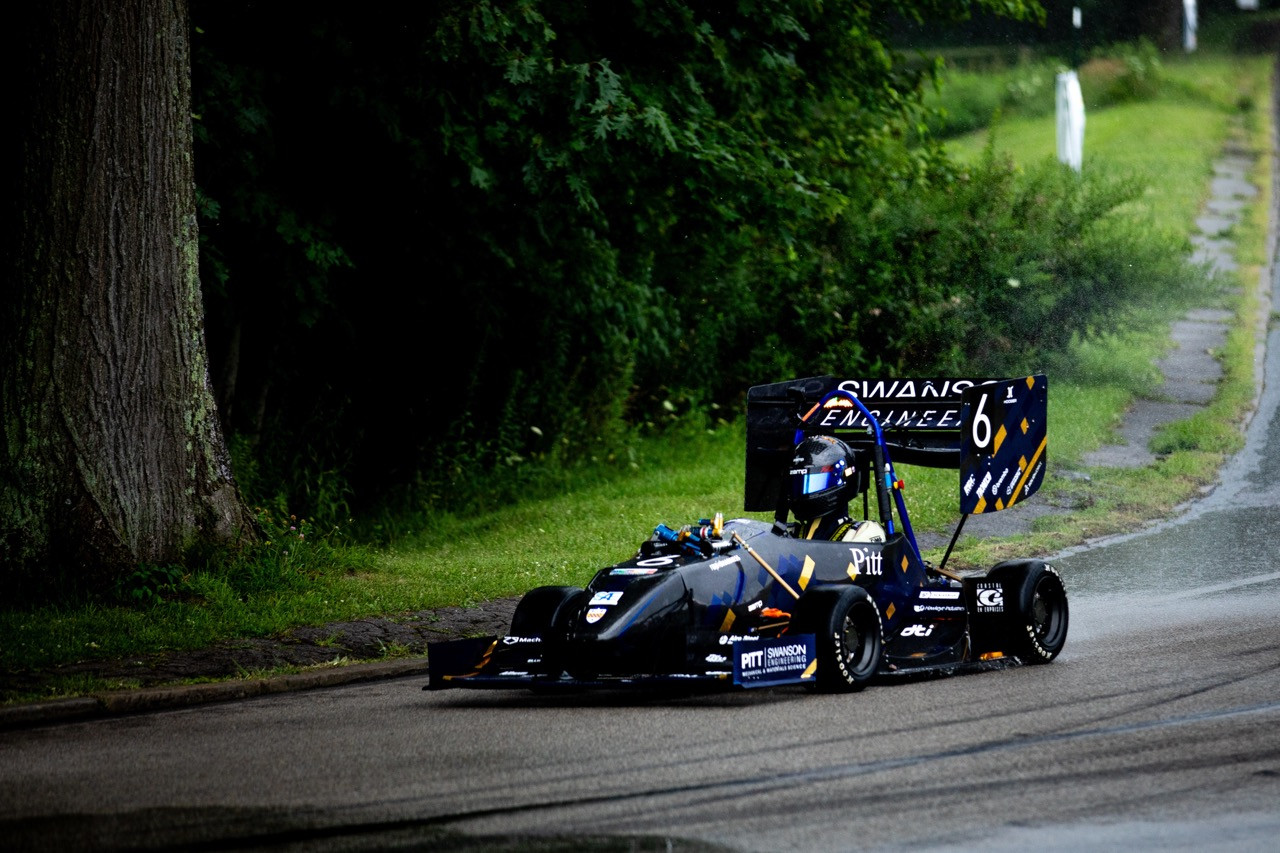
“The top teams have four-wheel-drive, in-hub motor systems, which are hard to stick,” Gillis said. “It’s like a big motor with a chain to the diff in each wheel, so you create smaller motors, which spin high and produce low torque. You put a little gearbox on them to step up the torque and step down the speed.”
“You need software algorithms to make the most out of the system,” added Lucas Campos, a fourth-year information science student and current executive director of Panther Racing. “There's a lot of math, coding, vehicle dynamics, and physics involved.”
It was a challenge the team was ready for. They set out to redesign and rebuild their car.
Sticking third place
After more than four decades of building race cars, the team has developed a cadence, passed on from one generation to the next. Each fall, they test the old car before they strip it down and start designing the new one, which they begin building in December. In most years, the car isn’t ready for testing until April or May.
The FSAE year culminates in May and June, when teams from around the world travel to race at the Michigan International Speedway in the small town of Brooklyn. This past June, 108 teams participated in the EV category alone.
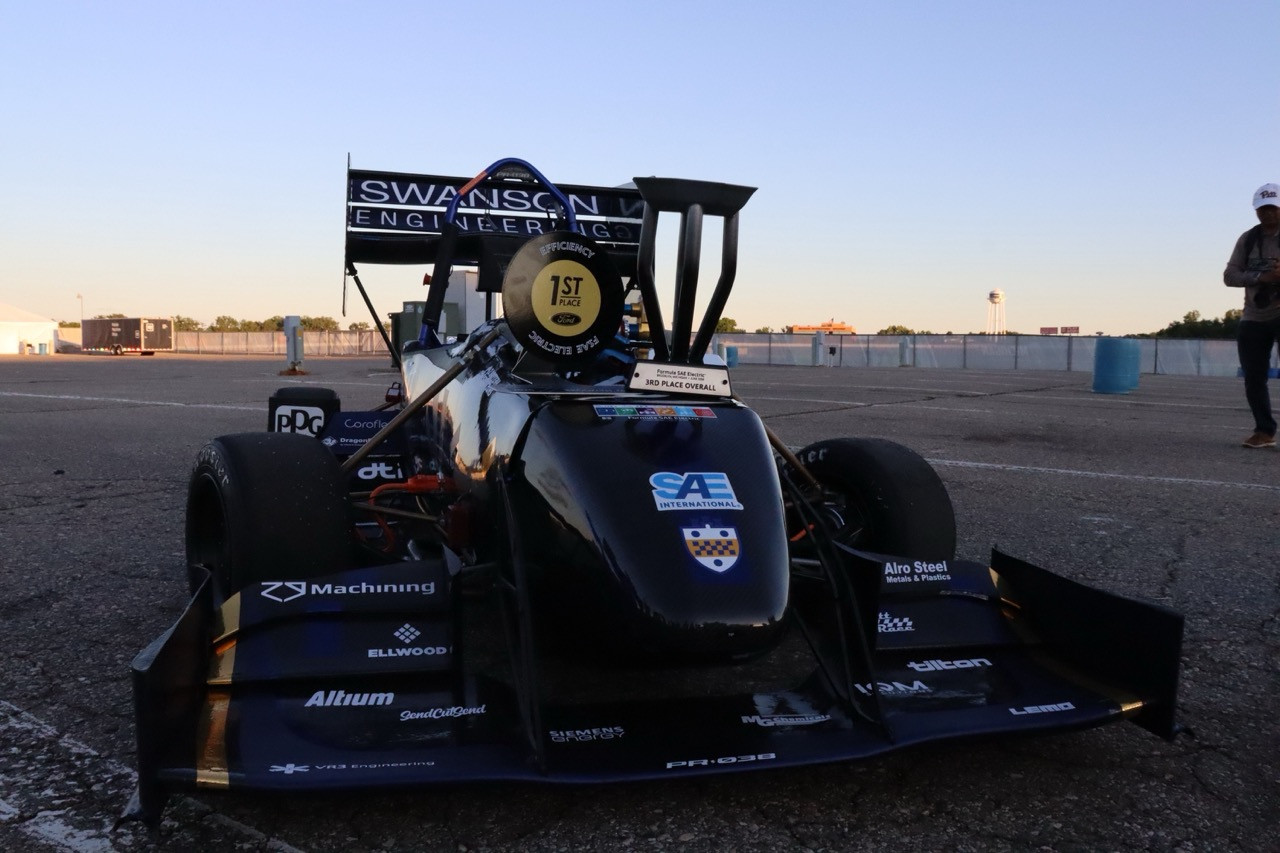
The competition, which lasts a week, is broken into static and dynamic testing. Each car is rigorously inspected, and teams must present on the design and cost. Cars, which are raced individually, are also judged on criteria including endurance, efficiency, acceleration, and skid pad.
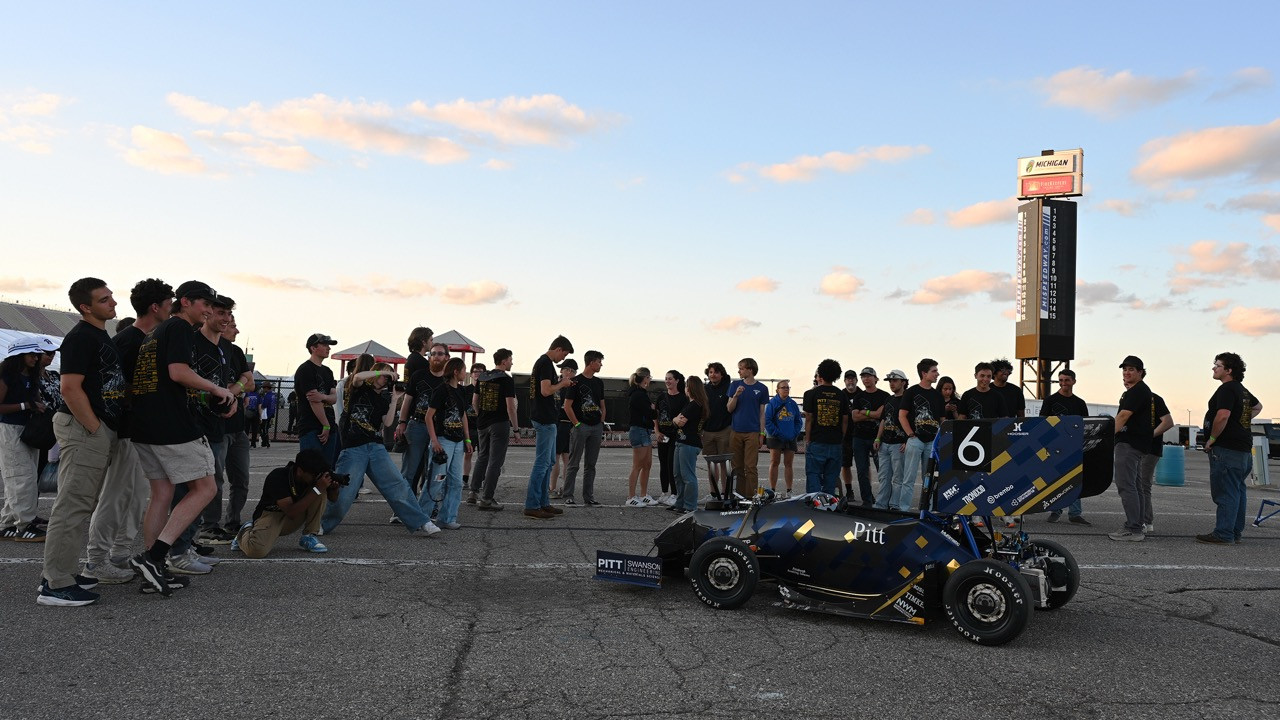
This year, 35 Panther Racing members traveled to Michigan. “It’s a unique experience and a chance for the team to connect,” Campos said. “We were out there all day in the rain. After a few days, the sun came out and it was ridiculously hot on the tarmac.”
The camaraderie extends to the different racing teams. Everyone wants to win, but they like learning about other cars and technology. Teams swap stories and spare parts.
“It’s a great experience,” Gillis said. “For everyone there, it’s a passion project.”
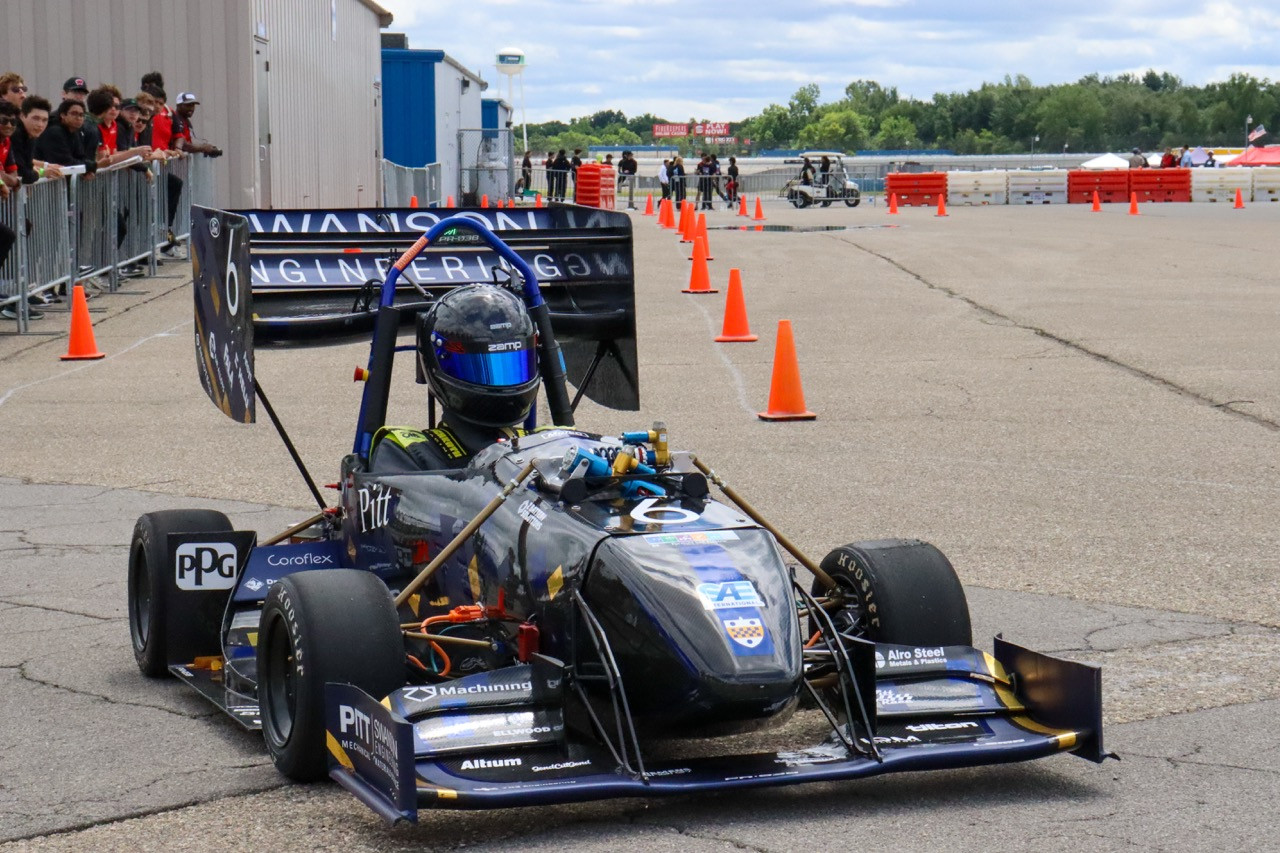
For Pitt’s team, it was also stressful. A component used in the motors they had built was recalled that spring, cutting into valuable time for testing and troubleshooting the new system. Before going to Michigan, the car had never successfully completed an endurance test, a 22-kilometer drive that many cars fail.
“We had some gearbox issues,” said Campos. “We tried one last-minute fix but didn't get to test it because it was down to the wire.”
The fix worked. On race day, Pitt’s car kept going.
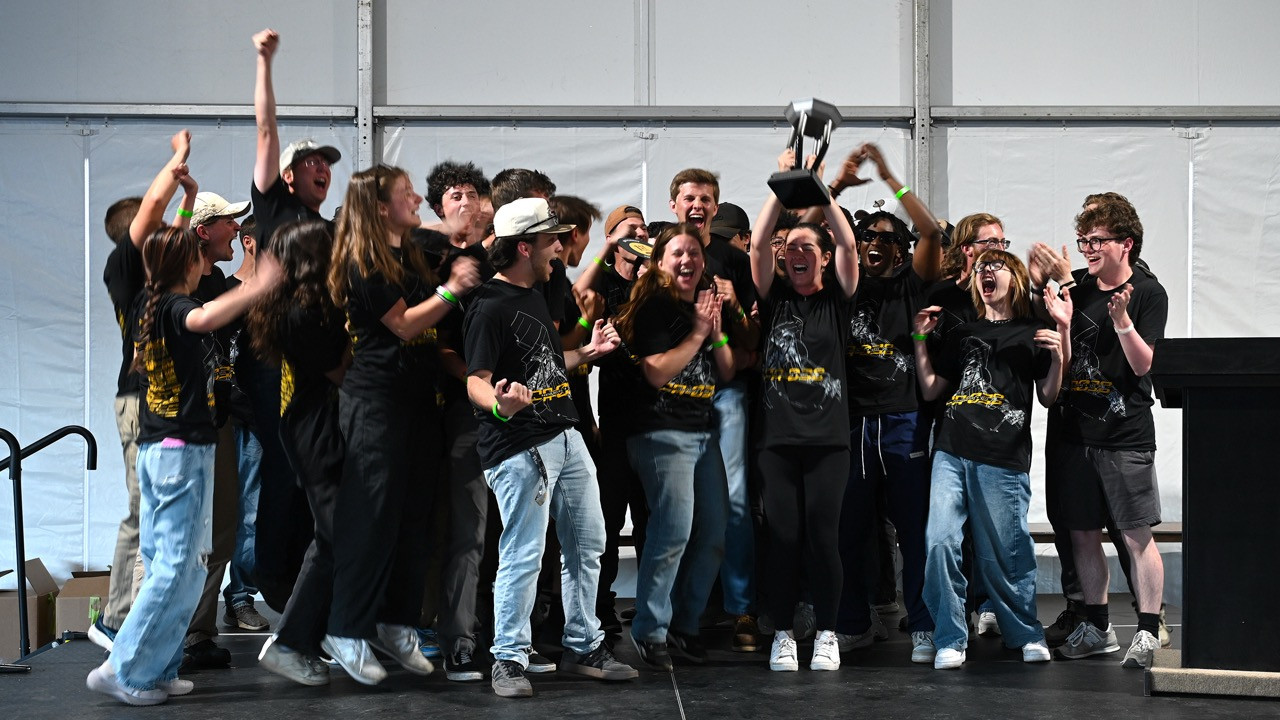
At the end of the week, results from all categories were combined and the winners were announced. “When we heard we got third place,” said Campos, “it was pure bliss.”
More than a race car
“If you’d asked me when I started at Pitt if I’d like to join a race car club, flat out I would’ve said, ‘No.’ I’m not an engineer. I didn’t take any math after Calculus 1,” said Celia Bayer, who served as the Panther Racing business director this past season.
Bayer, who studies marketing and business analytics and who will graduate in spring of 2027, was dragged by a friend to a Panther Racing event to help take pictures. The team asked her to assist with marketing, and she began attending meetings. Soon, she was hooked.
“My parents say that the most surprising thing about me in college is that I became a race person, but here we are.” Bayer is currently a University Recruiting Intern at Tesla.
Campos, who had modified his car in high school enough to annoy his mom, has always been “a car guy,” but he was drawn to computers. “I started in engineering but moved to information science,” he said. “I’m not what people probably think is your typical FSAE member.”
During his second year, Campos became more involved in Panther Racing and found a place where his interests in cars and computing could come together. “As FSAE continues to trend towards electric vehicles, and even autonomous vehicles, it’s going to be more software heavy.”
Ciavarelli had planned to study biology before switching to industrial engineering. Then she walked past the Panther Racing car in the Benedum Hall lobby. Intrigued, she followed it down to the sub-basement and all the way to the third-place finish.
Panther Racing’s finish depended on this range of interests and experience. It took engineers like Gillis, who had been fascinated with cars since rebuilding an old Willys Jeep with his dad. It took Campos and his expertise in software. It took a marketing and business analytics student who had never cared much about cars. Most of all, it took students willing to learn from one another and attempt something none of them could have accomplished alone.
For Ciavarelli, Panther Racing changed the course of her career. She switched majors to mechanical engineering and immersed herself in both the subject and the car. She now works at SpaceX as a propulsion engineer.
Looking back, Ciavarelli traces that path to the first time she followed the car downstairs: “I walked down there, and my parents and my friends say that I never came back out.”